
Lenoir Slave Records

Gen. William Lenoir was a diligent record keeper, and we are lucky that he was. He kept a wide assortment of journals, travel logs, survey notes, and expense books that provide us with a rare glimpse of day-to-day activity in northwestern North Carolina. Thousands of pages of Lenoir family papers have been preserved as part of a collection held at UNC Chapel Hill and available on 34 rolls of microfilm. With roughly 1,000 images per roll, that’s 34,000 images pertaining to local history from the 1770s until the mid 1900s. I’ve looked at many of these pages, but nowhere near all of them.
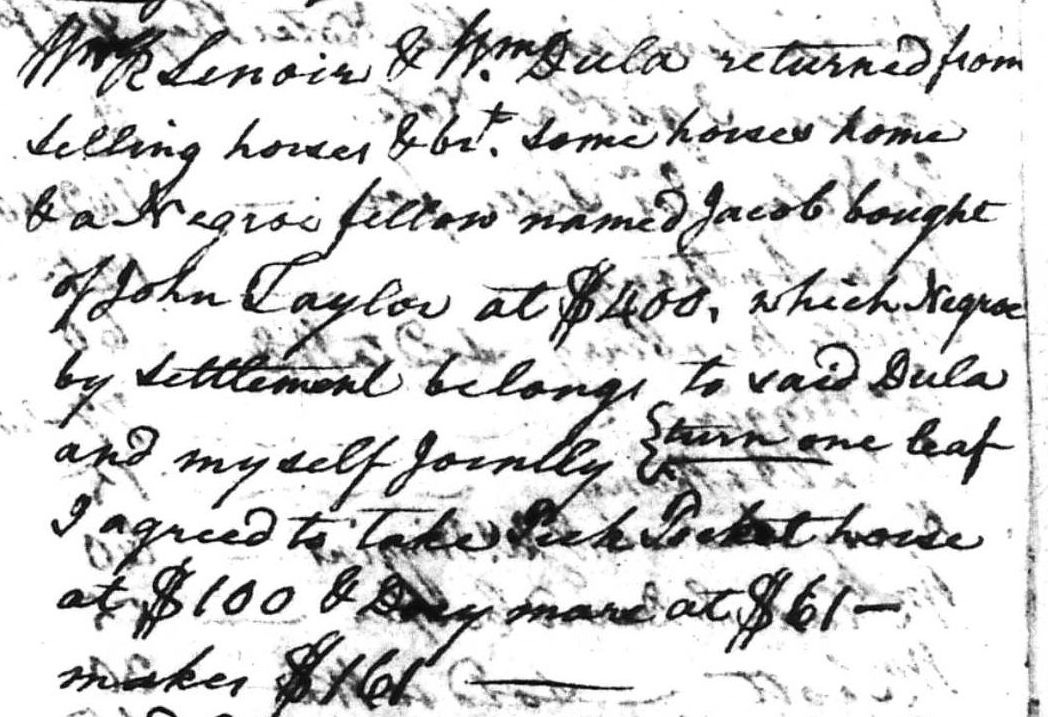
One of the topics that Lenoir documented was his slave transactions. Several pages include notes where he bought and sold slaves, as well as the names of whom he transacted with. Many entries include the names of the slaves and their ages. When his own slaves had children, he often listed them as a family unit and the birthdates of the children. I’m sure others have researched more about how he interacted with his slaves, but I haven’t. He might have recorded their names and ages because he cared for them, or perhaps it was a way of keeping an inventory of his property and assessing their value. But for genealogists and historians, any information from before the Civil War is valuable and worth studying.
With AI assistance, I processed about 2,000 pages of the Lenoir files and pulled out the ones that pertain to slavery. I then created a webpage to share this information. These documents primarily include the name of his own slaves, but some include the names of other slave owners who lived in the area. I asked AI to write mini-stories when the records provided enough information to do so, and it came up with eight glimpses into the lives of these slaves. One is about a failed escape attempt, and others explain how many of these enslaved people were related to each other. Each one is a reminder that they were people, too.

The webpage includes a name index of each of the enslaved people, but I almost erased it. I found errors in the transcriptions which meant that as many as 30% of the names were wrong. I made lots of corrections to the point where the errors are maybe 10% of the list. I decided that a 90% accurate list of names was better than no list at all. If I put enough time into it, I could make it even more accurate.
Every document image that is referenced in the list of names can be viewed by clicking on the filename in the “Image(s)” column. Filename r29-0337 means that the document is from microfilm reel 29, image 337.
I worked with AI Claude Code for many hours feeding it document images and asking it to create research guides and name indexes — both the names of slaves and of everyone else mentioned in these documents. While the transcriptions aren’t perfect, the research guides will help me search for information that I can use in other projects about local history from the late 1700s and early 1800s.
By sharing the names and experiences of the individuals who were enslaved over the span of nearly a century, we can learn more about their lives and about our shared history.
More history on my website.