
Where Did I Come From?
Creating a new map of my ancestors' birthplaces

UPDATE (July 24, 2026): One day after creating this tool to view my own Ancestor Map, I made some modifications so that it is now a tool that ANYONE can use! I introduced that in a new article here:
Ancestor Map Builder 2.0

Often one fun and exciting idea leads to another idea that is even more fun and exciting! That’s why I’m writing another map article just one day after introducing a tool that I created using Claude Code.
Now, the initial article about creating the tool (July 23, 2026)…
For 35 years, I’ve researched who my ancestors were, what they were like, and where they lived. I’ve proudly said that nearly all of my ancestors were from North Carolina and Virginia, and that when my people found a place to live, they stayed there for generations. Until now, I never fully appreciated just how true that statement was!
The other day I had an idea about creating a single map to show where all of my ancestors lived by representing each of them with a pin that was located at the place where they were born. Connecting lines would link the parent to the child, and together these lines would trace the the paths that led, generation by generation, to my birth in 1976.
So that’s what I did, and I really like the results!
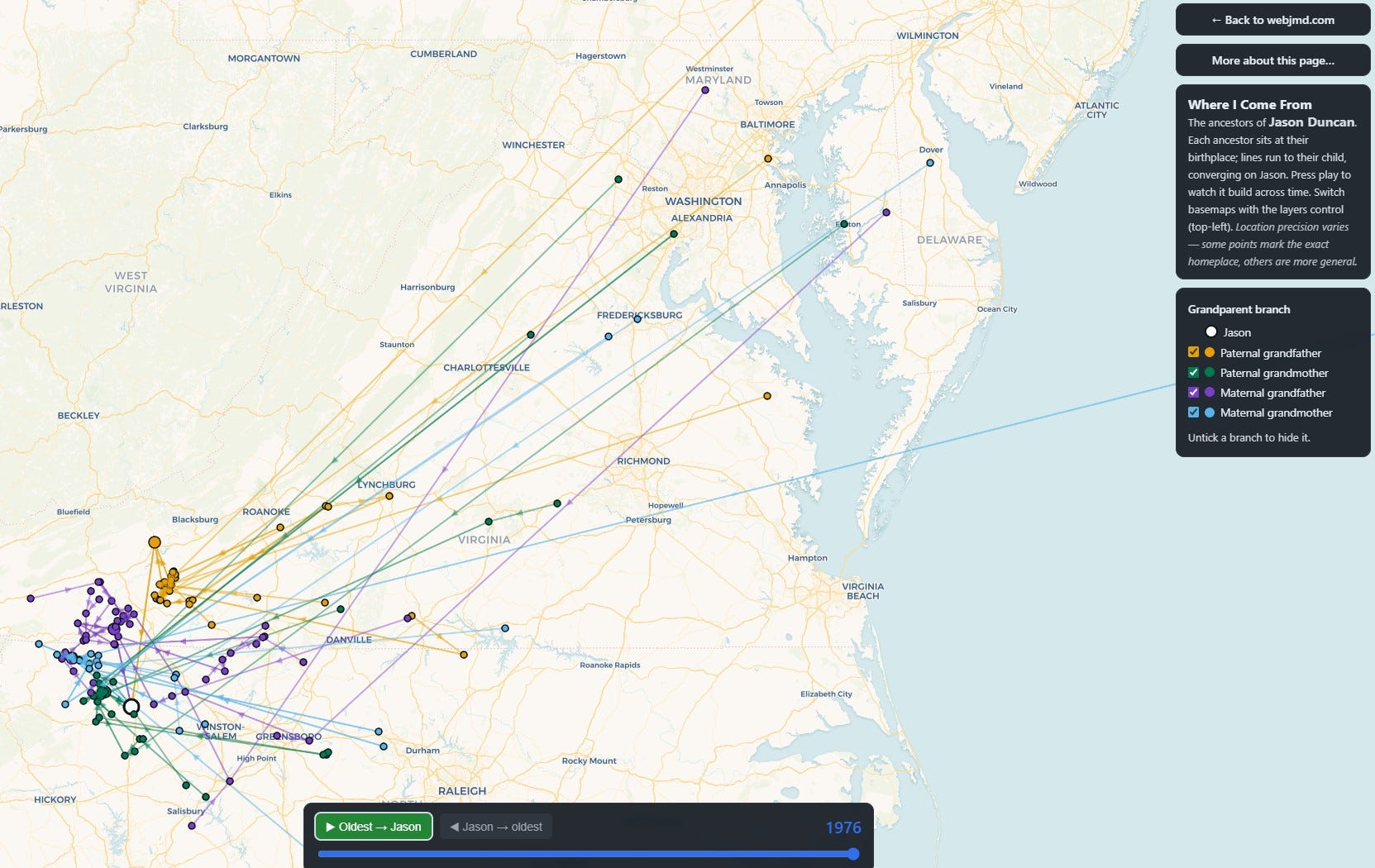
The map can be viewed on my website. Continue reading to see how I created it.
Using AI To Do More
I’ve recently been using AI to help me understand and process the history and genealogy documents that I’ve collected in courthouses, libraries, archives, from family members, and from online sources. I’ve used it to transcribe documents, summarize them, and present information in a way that I can share with others.
Like with any technology, AI can be used for good or for evil. It’s readily available at many different skill levels, and it’s not going away any time soon. I choose to use it for good by doing more with my genealogy hobby.
I also want to use AI to provide a new perspective on information that I’ve already seen. It’s often useful to have a friend look at something “with a fresh set of eyes” to see if there is something obvious that I missed. AI can serve as my genealogy buddy! Or, maybe long ago I dismissed a fact about my ancestor because it wasn’t important to me at the time. Today, I can have AI evaluate that same document, and by recontextualizing it, I see it as something that now has meaning.
AI is not simply a tool to do genealogy. It is a resource that allows me to do things that I would never have time to do on my own. If I have an idea for enhancing my website with a new feature — like the presentation of an 8,000-piece jigsaw puzzle of county land grants! — I don’t have to spend months learning how to write code for my website. AI can do that for me if I present it with accurate information and give it clear instructions of what I want to create. Usually, it creates something much better and more elaborate than I even imagined.
Creating My Ancestor Migration Map
For this project, I prompted Claude Code with an idea, asking it how best to represent the path of my ancestors on a map. I suggested using an Ahnentafel ancestor list with columns for birth year, birth place, and GPS coordinates. I manually entered the GPS coordinates of the places where my ancestors were born based on my research.
Since the 1990s, I’ve kept the names and dates of my ancestors in Family Treemaker software. It has an export function that creates a gedcom file, a text file with all of the data organized in a way that preserves the structure of my family tree. I gave that file to Claude and asked it to create a list of my ancestors in Ahnentafel format. That’s a fancy word for a list of all of my ancestors with each one assigned a number.
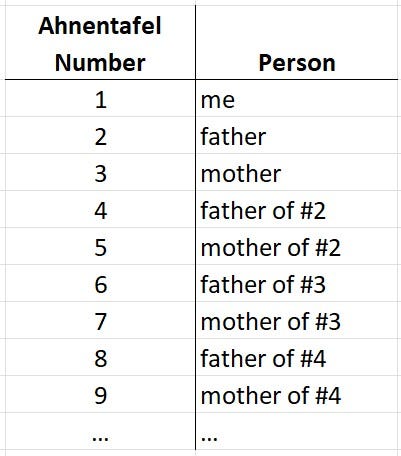
By giving each ancestor a number, it’s easy to mathematically determine the parents of any individual person. The father of n = n*2. The mother of n = n*2 + 1. This is important when writing a formula to connect the migration lines from parent to child. This number sequence can extend forever, but I decided to enter all of my ancestors back to and including my 5th great grandparents. Including me, that’s eight generations and 256 people!
I don’t have all of those people identified, and I don’t have birthplace information for all of the ones who are identified, but I filled in the data for everyone that I could.
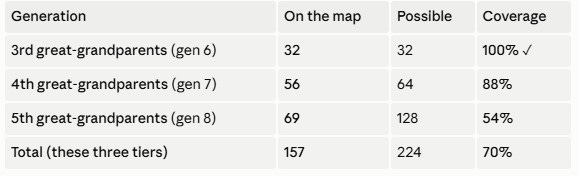
I was able to place all 32 of my 3rd great grandparents on the map; 56 of my 64 4th great grandparents; and 69 of my 128 5th great grandparents. I also wanted to know how far back in time this map represented. The average birth year of my 4th great grandparents was 1809, and the average for the prior generation was 1781. This was far enough back to visualize where most of my ancestors were living at the time of the Revolutionary War.

Claude suggested adding a timeline feature that would show the lines between parent and child developing as the years ticked by. We discussed color coding the points and lines, and we also determined their proper sizes. I asked it to add directional arrows to the lines to indicate the path from parent to child. Together, these flow lines are not unlike small streams and branches that flow into increasingly larger rivers before finally converging into one river that empties into the ocean. I am that final river!
Staying Put
From experience, I knew that my ancestors didn’t move very often or very far. That fact has made genealogy much easier because I rarely had to travel far to do research. This was especially true before so many records were digitized and made available online. But I didn’t realize just how true this was.
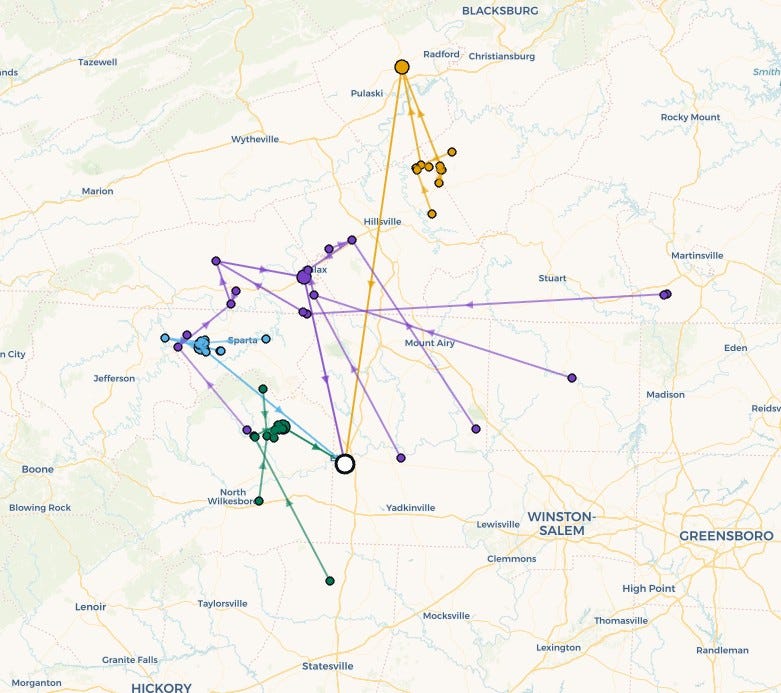
I have 60 ancestors who were born after 1830, and I know the birthplace of 59 of them. All 59 were born within 40 miles of a point near Mount Airy in Surry County. That’s an incredibly small region for nearly 200 years of ancestors!
When I take a look back at the ancestors born before 1830, the more distant locations appear on the map. Of the 186 points, only one line traces back to a foreign-born ancestor. Colen Williams was born in 1821 in the town of Gwinear in Cornwall, England. He, his parents, and two grandparents are the only five points located outside of the eastern United States on this map. He arrived at the port in New York City in 1857, and he soon made his way south and settled in Alleghany County.
The Map As A Research Tool
The migration map is a clear way to show which ancestors lived near others. This could lead to breaking through a brick wall on identifying someone’s parent or spouse. One thing that I noticed today was about my ancestor Josiah Walker who was born about 1770 and lived near Hays in Wilkes County in the early 1800s. I don’t know where he was born, so I wasn’t able to place him on the map. But in searching for his birthplace, I realized that he first shows up in Wilkes County in 1803 when he sold one acre on Roundabout Creek to Sterling Rose (Wilkes DB F1, p27). Roundabout Creek was also known as Grays Creek which flows north into the Yadkin River at Benjamin Cleveland’s Roundabout plantation near Ronda.
In 1805, Josiah Walker was dismissed from Brier Creek Baptist Church which was near the mouth of Grays Creek. I know very little else about him except that he had several children including my ancestor Willis Walker who was born in 1804. I’d love to find out where Josiah Walker came from!
From my land grants map, I know that there was a Howard Walker who, in 1785, bought at least 300 acres on Brier Creek less than three miles from the church that Josiah Walker attended and only one mile from the waters of Grays Creek. Surely this isn’t a coincidence! There must be a connection between my Josiah Walker and this Howard Walker. Perhaps Howard is an older brother, an uncle, or maybe even his father. This is an exciting new avenue to pursue.
I look forward to using this new ancestor migration map to see if it leads to any other new discoveries. Did I mention that it also has the option to use different base maps? The colored lines, each representing the ancestors of a different grandparent look really nice on the dark-shaded map!
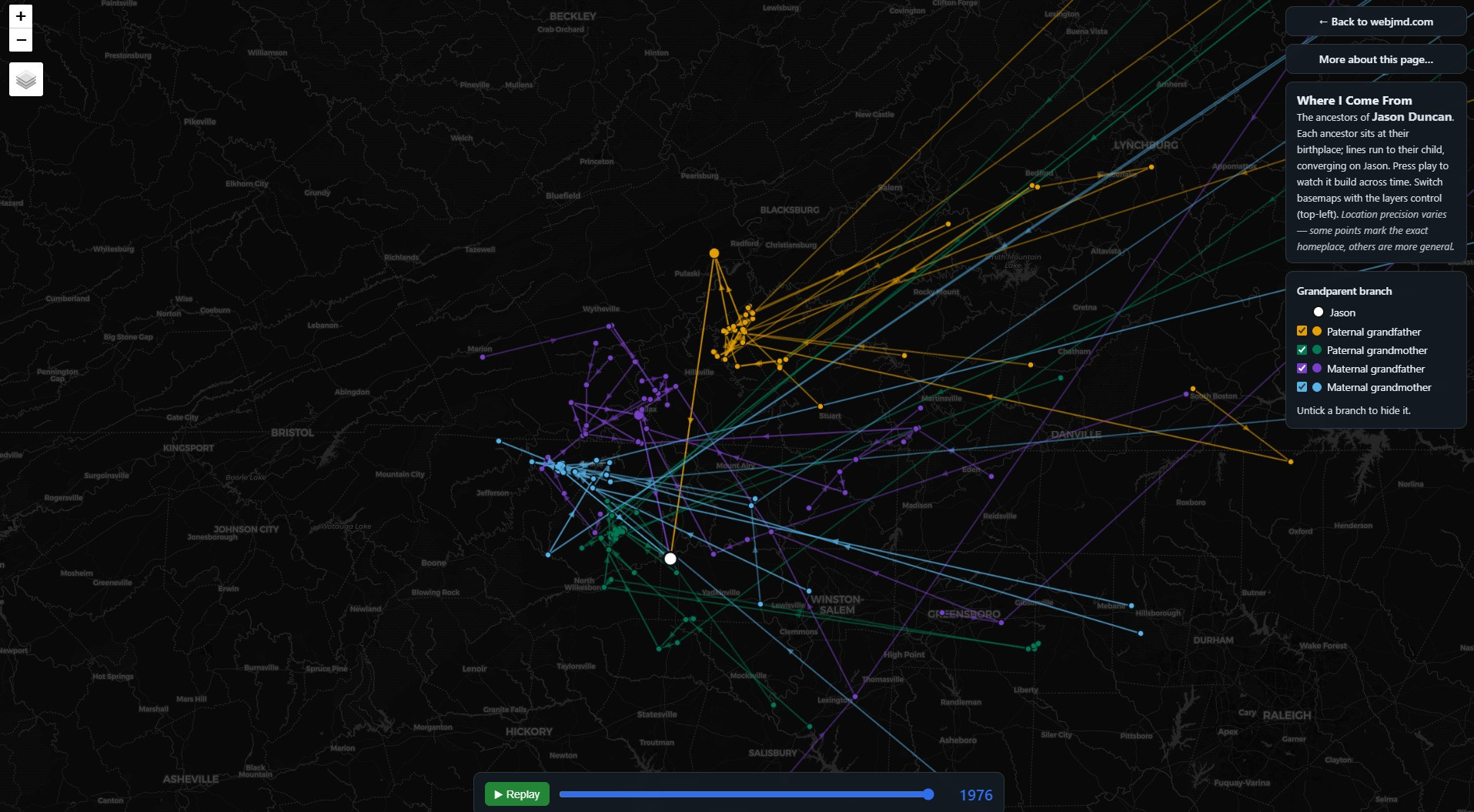
View the map on my website at https://webjmd.com/ancestormap/.
This is awesome, Jason! I would love to do something like this myself!
Fascinating. Thanks for sharing. I've wanted to map out part of my family tree and you've given me some inspiration!